I am still busy weeding and shovelling mushroom compost about, which doesn't make for very interesting posts.
However it has been allowing me to get a good look at my soil. A couple of years ago I visited the SEER centre near Blairgowrie where they have been experimenting with re-mineralisation of soil by adding in ground rock dust. The results are certainly impressive - bleak moorland has been transformed into a verdant garden full of giant vegetables. Experiments by other horticultural organisations have also found that the rockdust seems to be doing something - seedling deaths are fewer, plants more robust, vegetable yields higher.
Over the past 2 years I have added in 16 tons of rockdust into our raised beds - I used basalt from the Tarmac quarry near Dumbarton - and I believe that it makes a difference, particularly to the growth of bulbs. The tulips in the beds with rock dust were on average 4 inches taller than those grown in the beds without dust. My methods aren't exactly scientific - the dust also lightens the soil and improves drainage which may have an effect - but I believe that it is certainly worth it and a single application of rock dust should last several years as it gradually grinds down and gets incorporated into the soil.
One of the problems that domestic gardeners have had is that it is difficult to get hold of rock dust in small quantities. Now the SEER centre has begun to market bags of dust which are on sale at certain garden centres. I think that with worries about the lack of minerals in our vegetables that it is well worth digging in a bag or two to your vegetable patch.
For much, much more information (and for all the science) look at http://seercentre.org.uk
Monday, February 27, 2006


Saturday, February 25, 2006
Dahlias
 Now is the time to think about and order your new dahlia tubers. I have left last year's dahlias in the ground and they are fine and dandy at the moment with large firm tubers but I am also going to order some different varieties to try out.
Last year I was particularly impressed with the range of 'Karma' dahlias which have been specially bred for the cut flower industry. Usually 'bred as a cut flower' means that all quirky 'real flower' qualities have been bred out of the plant in favour of uniformity and stem length. With Karma dahlias however, the breeding to do with increased stem strength and vase life - an end to dahlias that last only a couple of days. I grew 2 varieties last year - Naomi and Fusciana - and both were great looking flowers that kept their heads up and lasted 8 days in a vase.
I have ordered enough tuders to be able to sell some at the Country Living Fair in March and here at the van on Fridays from April 7th.
Tuesday, February 21, 2006
Sarah Raven catalogue
Sarah Raven's Cutting Garden Spring catalogue is now out - and, as I look out at the brown and still weed ridden garden, making me very envious. Jonathan Buckley's photographs are so vivid and the garden so sunny and vibrant. . . .
http://www.thecuttinggarden.com
There is now also the opportunity to sign up for Sarah Raven's free garden email newsletter which should be interesting.
I am busy weeding the dahlia beds by day and working out what I can make to take to the Country Living Fair at the SECC next month by night.
http://www.thecuttinggarden.com
There is now also the opportunity to sign up for Sarah Raven's free garden email newsletter which should be interesting.
I am busy weeding the dahlia beds by day and working out what I can make to take to the Country Living Fair at the SECC next month by night.
Saturday, February 18, 2006
Amaryllis Giraffe
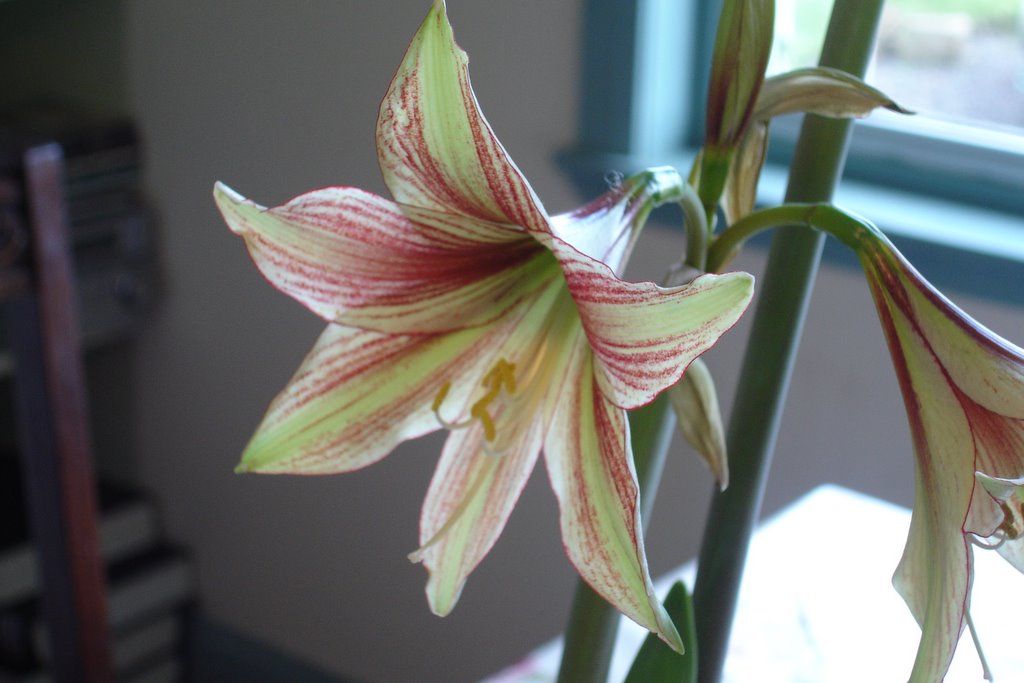
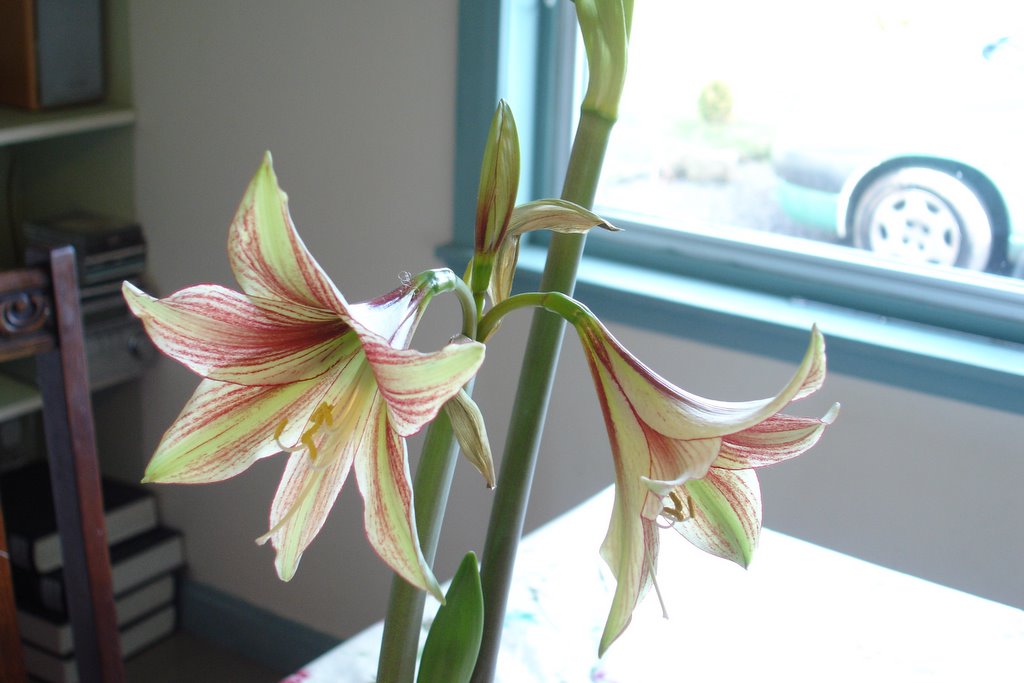
The miniature amaryllis 'Giraffe' is now flowering- what a little beauty. It is not actually that small - about 18 inches tall - and is going to have three flower spikes, each with 3 very elegant green green and raspberry pink striped flowers. Each year I forget how much I love Amaryllis - and how different most are from the supermarket "bulb in a box" affairs.
Today I met a friend whose mother had bought an Amaryllis 'Appleblossom' bulb from me at a Christmas Fair. She returned from holiday last week to find it flowering - massive pink and white striped trumpets on a stout stem - in its pot it was taller than her 4 year grandson!
Friday, February 17, 2006
Chickens
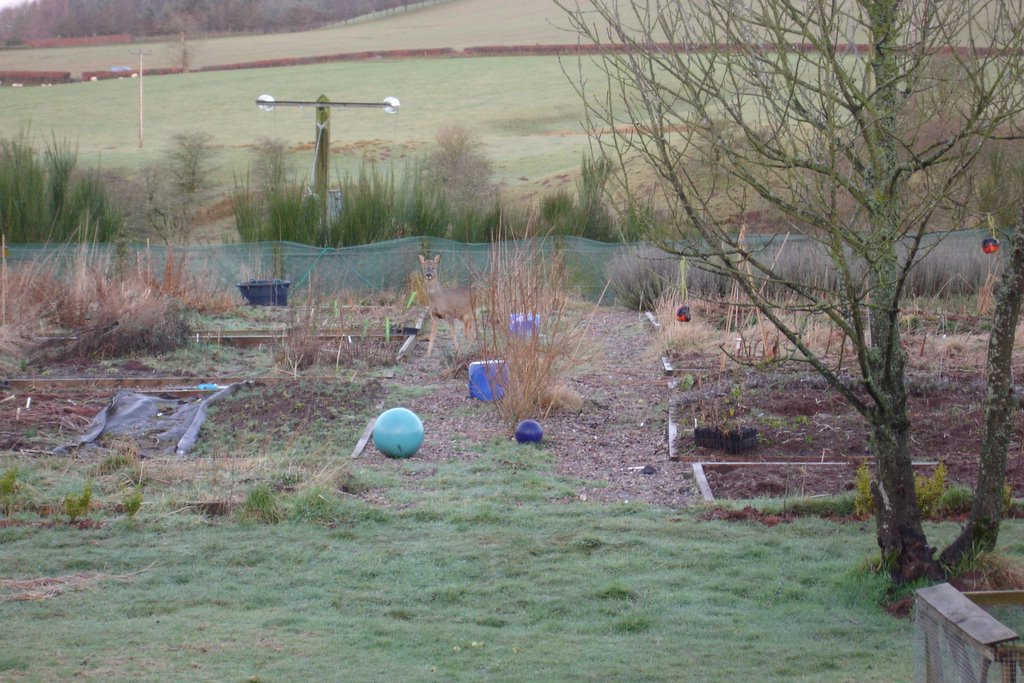
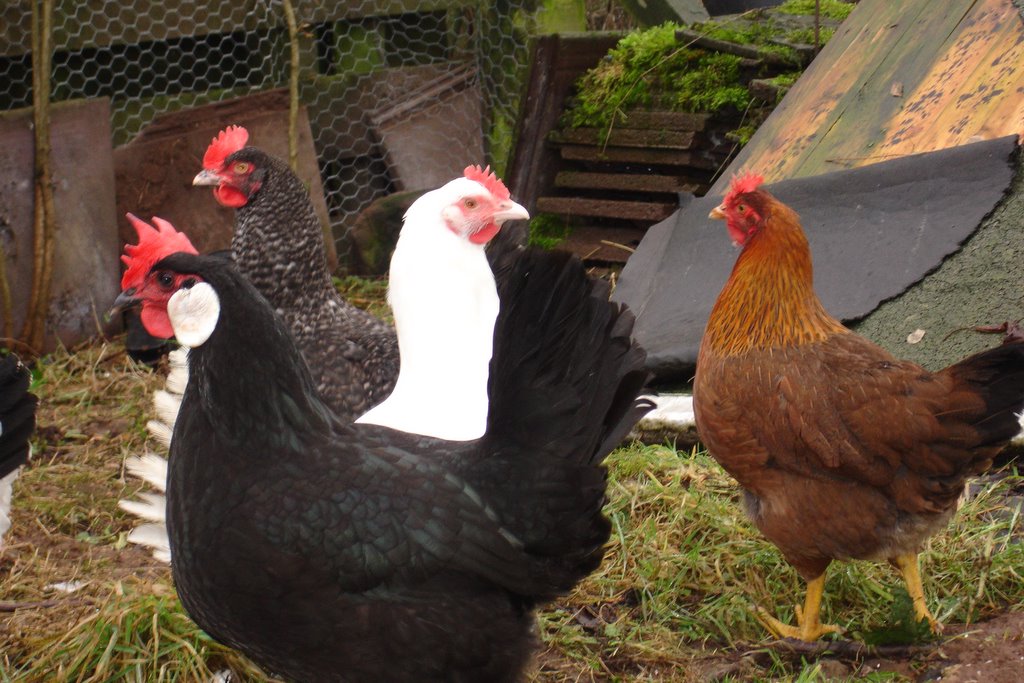
Our new chickens are now well settled into their run. We decided to do the "amateur pretty chickens" thing and got one of each of 6 breeds - black and white marans; light sussex; black majorcan; welsummer and a hybrid brown. Our original surviving maran - Peblo- who escaped the fox due to her amazing ability to fly 20 feet high in the air, and who moved in with our neighbours after the slaughter, has decided to move back in with us. The sorting out of pecking orders is much more violent than I had anticipated, but I am assured that it is largely show.
The other animal life in the garden at the moment is a very beautiful female roe deer who is happily munching tulip tops each morning when I get up. She appears in one of the photos here above and is not particularly frightened of either humans or dogs, but deigns to walk off down towards the wood when you go outside. I am trying to net all the tulips as they emerge so she will doubtless move on to destroy something else. I am not very commercially minded - it seems such a privilege to see wild animals so close.
Monday, February 13, 2006
Valentines Day
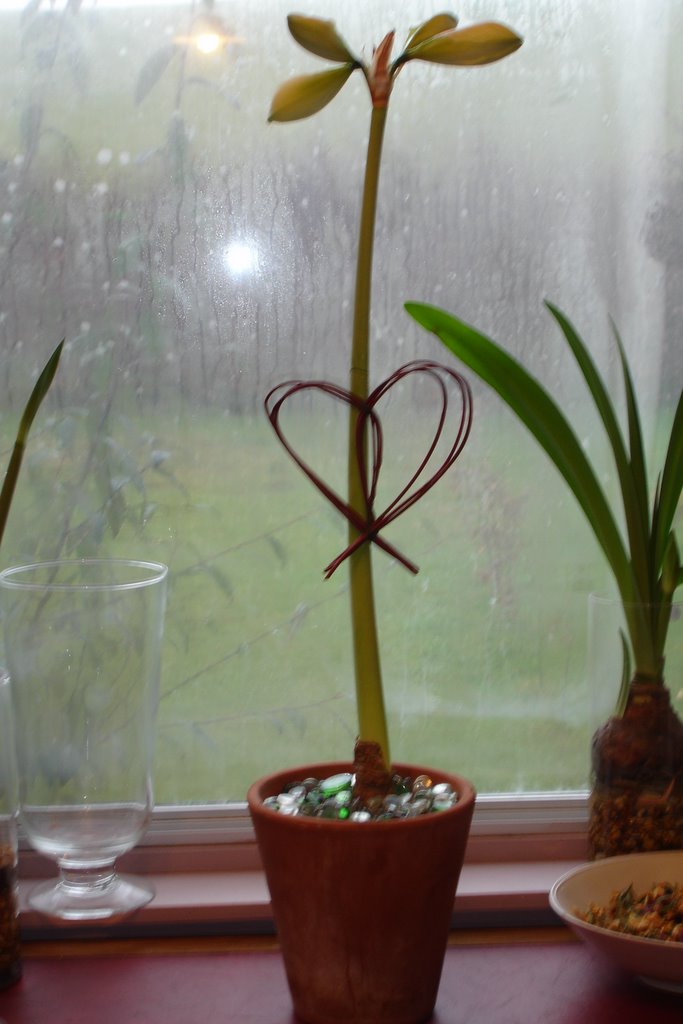
I am not really set up for Valentine's Day - the only flowers out in the field at the moment are snowdrops and a solitary iris reticulata- so the busiest day in the conventional florist's year passes me by.
If I did do valentine flowers . . . they would probably be like this - a fantastic white amaryllis called Ludwig Dazzler in a terracotta pot with a red dogwood heart. The amaryllis is the largest sized bulb commercially available and will have up to four flower spikes, one after the other, each with 4 massive trumpet flowers, much longer lasting that the customary dozen red roses.
I also think that small heart shaped wicker baskets potted up with snowdrops would be lovely and could be replanted outside after they were finished.
Saturday, February 11, 2006
Holiday?- not here!
 It is half term holiday here this week and most of the girls' classmates seem to have headed away to chase some winter sun.
 Here however we have been well wrapped up and busy outside. Here is Katie with her hoe outside the new chicken run - (replacement chickens arrive tomorrow).
She was helping to plant a hornbeam hedge which is now being well watered in by the rain which has turned torrential and driven us inside to stamp labels and string up beaded wire.
Friday, February 10, 2006
Forcing spring branches

Now is the ideal time for bringing bare branches of spring flowering shrubs and trees into the house and watching as leaves and flowers gradually unfurl. The flowers and leaves on shrubs and trees are formed during the autumn and then need a period of cold weather - usually about 6 weeks - before their dormancy can be broken by bringing them into the warmth.
The longer that their cold period is, the quicker they will bloom inside - branches cut at the end of January may take several weeks - ones cut in March will probably bloom in a fortnight.
One of the easiest plants to force in this way is forsythia - I picked these this morning and already the buds are beginning to open up. I am putting them on a hall table with pots of blue hyacinths. The cooler the room the longer lasting the display.
Fruit trees are also great for forcing - my father prunes his peach tree about now and we gather up the prunings and pop the bare sticks into water - within a couple of weeks they are festooned with peach blossom.
Other suitable candidates are willow, pieris, horse chestnut, witchhazel and maples. Forcing is very easy - simply cut the branches and put them into tepid water - if the bud scales are hard e.g. willows then it can be worthwhile floating the entire branch in the bath to soften the scales but this isn't really necessary. Nature really takes care of it.
Wednesday, February 08, 2006
Mushroom compost


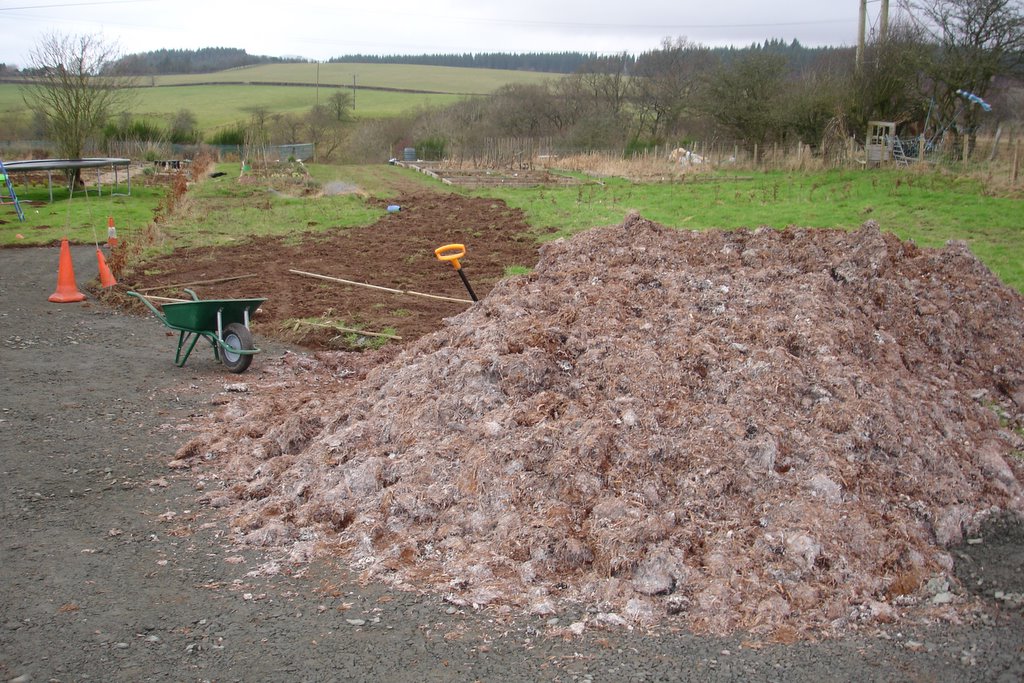
These photos show the beds before weeding - and then after mulching - along with a view of the 7 tons heap of compost that I hope to move this week. The bit of green behind the heap is where this year's new raised beds will be going and the hardcore in the foreground will be the new gravelled and flagged drive by the beginning of April which is when we shall be opening up again. The cones mark the edge of a new greenhouse.
The bulk bought mushroom compost looks a bit wierd when you first put it on - there is still plenty of mycelium in it, so from a distance it looks like frost. We are getting quite a few good looking mushrooms popping up on the heap so I may be batch making mushroom soup at the weekend.
The telephone number for Silverbirch (Scotland) which delivers beautiful, bagged mushroom compost (they call it soil imporover or conditioner) is 0141 777 5050. I really recommend the product for mulching or digging into the soil and the price is very reasonable. You can also reach them at admin.silverbirch@virgin.net.
Tuesday, February 07, 2006
Cold weather


The hoar frost of January was fantastic - the field looked wonderful with frozen seedheads like the ones in glossy magazines. Now that it has all melted we are back to looking at mushy brown leaves and emerging weeds. The weeding has begun properly - grubbing away with an old kitchen fork at creeping buttercups and hoing off the chick weed. I have got 7 tons of mushroom compost which I shall be using as a mulch over all the raised beds this year. The idea is that it will be put on each bed just after weeding - put on about 4 inches deep - to exclude light and stop any weed seeds from germinating. This all has to be done before the plants put on much growth as that I don't inadvertently smother them as well.
Mushroom compost should work well as a mulch - it is light, dense and weedfree and will gradually rot down and enrich the soil. On a much smaller scale I used mushroom compost from Silver Birch to mulch in my last garden and over a couple of years it built up fantastic crumbly loam from what had been a sticky clay. The only problem with it is that it contains lime chips, so should not be used with acid loving plants such as rhododendrons.
Subscribe to:
Posts (Atom)